
How Do I Frame and Build Garage Walls for My Home Project?
Staring at an empty garage and feeling unsure about framing those walls yourself? I will guide you through the entire process with clear, shop-tested steps from my own renovations.
We will cover planning your layout with a laser level, choosing between standard SPF and pressure-treated lumber, cutting studs accurately with a miter saw, and assembling a sturdy frame that meets local building codes.
I have built and repaired garage walls for years using tools like a DeWalt DWS780 miter saw and Simpson Strong-Tie hardware, so you are getting advice from hands-on experience.
Plan Your Garage Wall Layout and Materials
Before you buy a single 2×4, ask yourself what this garage is for. Is it a woodshop needing extra support for wall-mounted cabinets? Is it mainly for storage, where you’ll want slatwall panels? Your answer decides everything. A basic workshop needs sturdy, true walls you can hang anything on. A storage garage might get by with simpler framing but needs precise spacing for your shelving system. As you plan the garage workshop conversion, map out layout, electrical, and ventilation needs. This foresight will keep framing and mounting decisions aligned with your actual workflow.
I always start with a pencil sketch on graph paper. It doesn’t have to be perfect. Just draw your garage footprint, mark the doors and windows, and think about where your workbench or big tool chest will go. This simple sketch prevents the costly mistake of framing a wall right where you need to roll out a large tool cabinet.
Once you have a sketch, you must check for underground utilities before you mark your layout on the concrete floor. Call 811. It’s free, it’s the law, and I’ve seen a backhoe operator cut a fiber line that shut down a whole block. Don’t be that person.
For materials, you’ll need three main things: the bottom plate, the studs, and the sheathing.
- Your bottom plate sits directly on the concrete. You must use pressure-treated lumber here. Concrete wicks moisture, and a standard pine 2×4 will rot in a few years. I buy the green-treated ones from the big-box store.
- For the wall studs, standard kiln-dried spruce-pine-fir (SPF) 2x4s are the go-to. Buy 10-20% extra to sort through for the straightest pieces. The crooked ones can be cut into blocking later.
- Headers go above doors and wide windows to carry the load. For a single garage door in a non-load-bearing wall, two 2x12s with a spacer is a common fix. For anything wider or load-bearing, I skip the guesswork and use an LVL (Laminated Veneer Lumber). An LVL is an engineered wood beam that’s stronger and straighter than nailing three 2x12s together. It’s more money upfront, but it won’t sag or warp over decades.
- Sheathing is your wall’s skin. Use 1/2-inch plywood for maximum strength to hang anything anywhere, or 7/16-inch OSB (oriented strand board) for a more budget-friendly, perfectly adequate option for most garages. I used OSB in my last build and have no complaints.
You asked, “How do I plan the layout?” Start with your garage’s purpose and a rough sketch. “What materials are needed?” Pressure-treated wood for the base, straight studs, strong headers (consider LVL), and your choice of plywood or OSB skin. That planning also ties into organizing garage workshop layouts—design zones for work, storage, and movement. In the next steps, we’ll connect these ideas to a practical workshop layout.
The Gearhead’s Checklist: Tools You’ll Actually Use
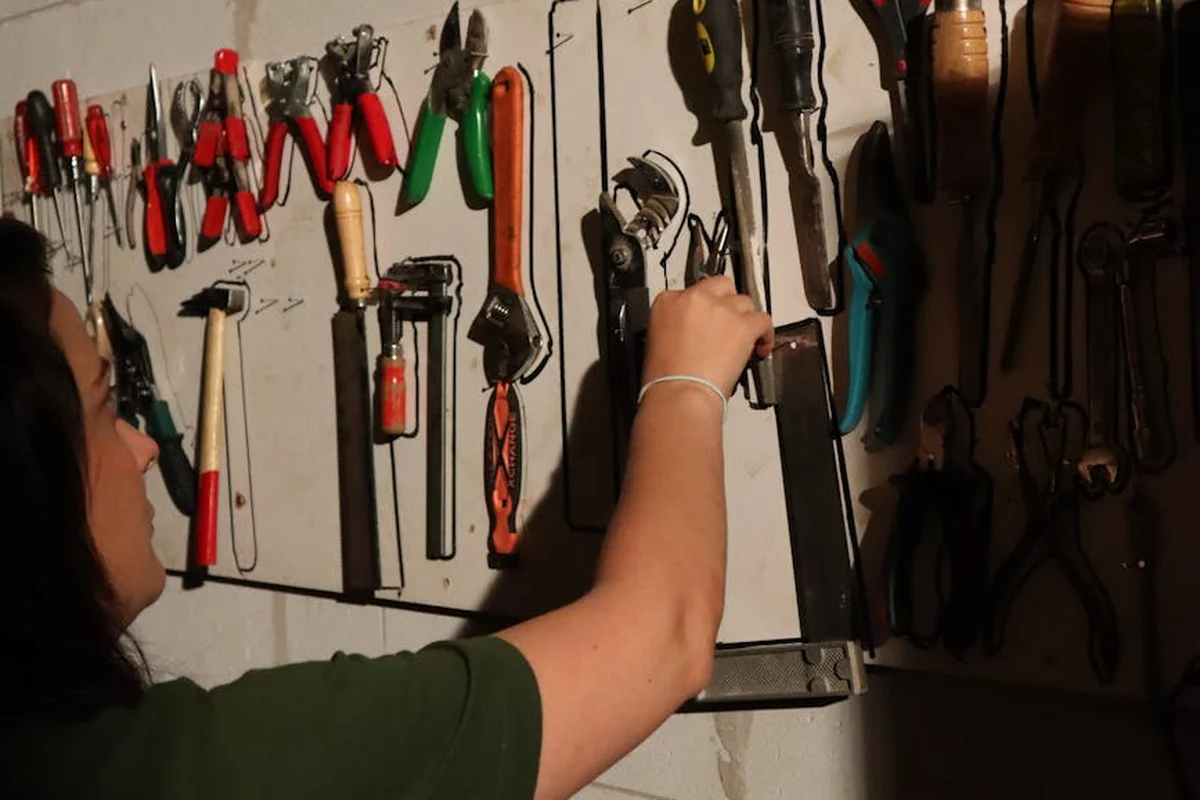
You can’t build a wall with a Swiss Army knife. These are the tools I grab for every framing job. A 20-ounce framing hammer has the heft to drive 16d nails without wearing out your arm. Your most-used tool will be a cordless drill/driver. I’ve used them all, and my Milwaukee M18 Fuel is the one I trust. The battery lasts all day, and it has the torque to sink long screws into dense LVL beams without stalling.
A circular saw is for making the hundreds of cuts. Don’t buy the cheapest one. A mid-range saw from a reputable brand will have a better base plate for straighter cuts. A reliable 4-foot level is non-negotiable for plumbing your walls. Check your level’s accuracy before you start by holding it against a known flat surface, flipping it, and making sure the bubble reads the same.
If you’re framing more than one wall, consider renting or buying a pneumatic nail gun. It’s faster, more consistent, and easier on your joints than hand-nailing. A Porter-Cable framing nailer kit with a small compressor is a solid, dependable choice I’ve seen in many home shops. For laying out long walls perfectly straight, a simple laser level is a game-changer. Set it on the floor, and you have a perfect line to align your bottom plate.
Never skimp on safety gear. Impact-resistant glasses stop flying wood chips and concrete fragments. Hearing protection is mandatory with a compressor and saw running all day. A good pair of sturdy work gloves protect your hands from splinters and sharp metal fasteners. This gear isn’t optional; it’s what lets you finish the project without a trip to the clinic.
The tools required are a good hammer, a powerful drill, a circular saw, a long level, and full safety gear. Adding a nail gun and laser level turns a big job into a manageable one.
Frame and Raise Your First Wall Section
This is where your garage starts to take shape. We’re going to build the wall lying down on the garage floor, then stand it up. It’s much safer and more accurate than trying to frame in place.
Lay Out Your Plates and Mark for Studs
You’ll need two pieces of lumber the exact length of your wall: the bottom plate and the top plate. I always use a chalk line snapped on the floor as a guide to keep them perfectly straight. Lay them side-by-side on the floor.
The most critical step here is marking your stud locations on both plates at the same time. Grab your tape measure and framing square. Starting from one end, make a mark at 15-1/4 inches. Your next mark is at 16 inches, and then every 16 inches after that (31-1/4″, 32″, 47-1/4″, 48″, etc.). This “16 inches on center” spacing is standard. The 15-1/4″ mark is for the edge of your first stud, which accounts for the half-inch thickness of your sheathing or drywall. Mark a big “X” on the side of the line where the stud will go. Doing both plates together guarantees all your studs will be aligned.
Measure and Cut Your Studs Accurately
Your studs run vertically between the top and bottom plates. Here’s the trick to getting the length right. First, measure the height from your garage floor to the bottom of the ceiling joists (or top plate of the existing wall). Let’s say it’s 8 feet exactly (96 inches). A standard bottom and top plate are each 1.5 inches thick. Combined, that’s 3 inches.
Subtract 3 inches from your ceiling height: 96″ – 3″ = 93″. That’s your stud length. But I add an extra 1/8 inch (93 1/8″) for a little wiggle room when standing the wall up. It’s easier to tap a slightly long stud into place than to fight with one that’s too short. I use a DeWalt power miter saw for fast, square cuts on all my studs.
Assemble the Wall on the Floor
With your plates marked and studs cut, assembly is straightforward. Place your studs between the plates on their marked “X” lines. To secure them, use the “toenailing” technique: drive a 16d common nail or a 3-inch construction screw at an angle through the stud and into the plate. I prefer screws (like GRK Fasteners’ R4) for this because they pull the wood tight and are easier to correct if you make a mistake. Use two fasteners on one side, then two on the other to lock it in. Before you fasten every stud, use a long level or a straight 2×4 to check that the stud edges are flush with the plate edges.
Once all studs are in, check that your wall is square. Measure diagonally from corner to corner. If both diagonal measurements are equal, your wall is square. If not, push on the long corner until they match. This is called the 3-4-5 method scaled up.
Raise and Secure the Wall
Do not attempt this alone. You need at least one other strong person. Position yourselves in the middle of the wall. On the count of three, lift the wall up and walk it into position against your chalk line. It’s awkward and heavy, so communicate and lift with your legs.
Once it’s roughly in place, have your helper hold it while you tack a long, temporary 2×4 brace from the top of the wall to the floor or a secure joist. This keeps it from falling over. Now, check that the wall is perfectly plumb (vertical) with a 4-foot level. Adjust the brace as needed.
Finally, secure it permanently. Nail or screw through the bottom plate into the wood floor framing or concrete slab (using a hammer drill and concrete anchors). Also, nail through the top plate into the ceiling rim joist or framing above. Remove the temporary brace once the wall is fully secured at top and bottom.
DIY Difficulty & Time Estimate
I rate wall framing a solid 7 out of 10 on the DIY difficulty scale. The concepts are simple, but the work is physically demanding and demands precision. A slight error in layout multiplies down the line.
For a basic two-car garage (three walls, one with a large door opening), plan for 3 to 4 full days of active work for a two-person team. There’s no glue drying time, but your local building inspector will need to see the framing before you insulate or drywall, which can add days to your schedule. This is absolutely not a one-person job; the risk of injury or a falling wall section is too high.
Build Strong Corners, Headers, and Openings
Regular walls are one thing, but the strength of your garage comes from how you handle the corners and openings for doors and windows. This is where you build in durability, which is crucial when you inspect your garage for structural issues.
Framing a Solid Corner
You never frame a corner with just two studs. That creates a weak spot with nowhere to attach drywall on the inside corner. The standard method uses three studs to form an “L” shape, creating a sturdy nook for drywall and a massively rigid connection. Here’s how I do it: nail two studs together flat to form a corner post. Then, offset a third stud by 1.5 inches from the inside edge of one of them. This offset creates the 90-degree pocket that your drywall panels will fit into. Nail everything together securely. This three-stud corner is what keeps your garage walls from racking or twisting over time.
Understanding and Building Headers
Any opening in a load-bearing wall-like your main garage door or a man door-needs a header. The header is a horizontal beam that carries the weight of the house above the opening and transfers it down to the foundation through the jack studs. For a garage door, this is non-negotiable.
I build my own headers from two pieces of 2×12 lumber with a 1/2-inch layer of plywood sandwiched between them. This makes the header the same 3.5-inch thickness as a 2×4 wall. The size of the header (like a 2×10 vs. a 2×12) and whether it needs to be doubled or tripled depends on the width of the opening and your local building code. Always check your code, but for a typical 16-foot garage door, a double 2×12 header is almost always required. I glue and nail the three layers together with 16d nails every 12 inches along the edges.
Framing the Rough Opening
Let’s walk through framing for a garage door. First, you install the king studs-full-height studs that run from floor to ceiling on each side of the opening. Next, measure the rough opening for the garage door from the floor to where the bottom of your header will sit. Here, you install the jack studs (also called trimmer studs) nailed flush to the inside of each king stud. These jack studs are cut to support the header.
Set your built header on top of the jack studs and nail through the king stud into the ends of the header. Above the header, you install short cripple studs spaced 16 inches on center, running from the header up to the top plate. These provide a nailing surface for your siding and sheathing. The jack studs carry the load down, the header carries it across, and the king studs tie it all into the full wall structure. The same principles, on a smaller scale, apply to window and walk-through door openings.
Make It Straight: Plumb, Square, and Sheathed

Getting the skeleton straight is everything. A wall that’s out of plumb (vertical) or out of square (90-degree corners) will haunt every step that follows, from hanging sheathing to installing cabinets.
To check for plumb, I use a 4-foot level against the studs. For a more accurate check over a long span, clamp a long, straight 2×4 to the face of the wall studs and then place your level against that. This averages out any minor bows in a single stud and gives you the true line of the whole wall. Tap the bottom plate with a sledgehammer to adjust the wall until your bubble is centered.
Before you add permanent braces or sheathing, you must check for square. The carpenter’s trick is the 3-4-5 triangle. Measure 3 feet from the corner along one wall plate and make a mark. Measure 4 feet from the same corner along the other plate and make a mark. The diagonal distance between those two marks must be exactly 5 feet. If it’s not, you need to adjust the wall-usually by pushing or pulling the top plate-until it is. This method works at any scale (6-8-10 feet is even more accurate for garage-sized walls).
FAQs: Making It Straight
How do I ensure the walls are plumb and square?
Do it in this order: square first, then plumb. Brace the wall temporarily with long 2x4s nailed at an angle from the top plate to the floor. Use the 3-4-5 method to get the corner perfect and nail those braces. Then, use your level to get the wall perfectly vertical and secure all your braces. Don’t skip either step.
How do I add sheathing to the exterior?
Sheathing, like OSB or plywood, is what makes your wall a rigid box. Start at a bottom corner. Always stagger the vertical seams from one row to the next, like laying bricks; never let four corners meet at one point. I use 8d galvanized nails or 2-1/2 inch exterior-grade screws every 6 inches along the panel edges and every 12 inches in the field. Leave a 1/8-inch gap between panels for expansion. A chalk line snapped across the studs helps you keep the bottom edge straight.
Sheathing Options: A Pro’s Take
You have two main choices at the lumberyard.
- OSB (Oriented Strand Board): This is the most cost-effective. I’ve used it for years. It gets the job done, but I don’t like how it behaves if it gets wet. It can swell and stay swollen. It’s fine for a dry, well-sealed garage.
- Plywood (CDX or similar): This is stronger and more moisture-resistant. If I’m building in a damp climate or just want the extra durability, I spend the extra 20% for 1/2-inch CDX plywood. It holds fasteners better and I trust it more over the long haul.
Cost & Value Breakdown
When you budget, think in tiers. I tell homeowners to pick the tier that matches how long they plan to own the home and how they use the garage.
- Good: SPF (Spruce-Pine-Fir) studs and 7/16-inch OSB sheathing. This is the standard builder-grade package. It meets code and works fine for basic storage and parking.
- Better: #2 Grade or better kiln-dried studs (they twist less) and 1/2-inch CDX plywood. This is my sweet spot for a serious DIYer. The lumber is straighter, making framing easier, and the plywood is a noticeable upgrade.
- Best: All kiln-dried, premium plywood like AdvanTech for sheathing. This is for the forever home or a garage that’s becoming a finished workshop. The panels are engineered to be stronger and more stable, with a moisture warranty.
The big sticker shock isn’t the studs and sheathing-it’s all the little stuff you forget. Budget for concrete fasteners (like Ramset nails or wedge anchors), a whole box of galvanized framing nails or screws, and Simpson Strong-Tie hurricane ties if your local code requires them. Also, rent a small dumpster. The pile of cut-offs and packaging gets huge, fast.
One small investment that pays off immediately: a good circular saw blade. The thin, dull blades that come with saws tear the wood. I buy a Diablo 40-tooth framing blade. It costs about $25, cuts cleaner with less effort, and is safer because it doesn’t bind as much.
Understand Codes and Frame for the Future

Building codes aren’t suggestions; they’re the rules for safety. For an attached garage, fire separation requirements are especially crucial. You will likely need 5/8-inch Type X (fire-rated) drywall on the walls and ceiling shared with your living space. This gives you a crucial buffer in case of a fire. Always check with your local building department for your specific requirements.
Other universal codes: studs are typically spaced 16 or 24 inches apart, measured from the center of one stud to the next (called “on center”). Use the proper nail or screw type and quantity as specified for your connections-this “fastening schedule” is what gives the structure its strength.
FAQs: Codes and Planning
What are the building code considerations?
Beyond fire-rated walls for attached garages, focus on maximum stud spacing (16″ on center is sturdier for hanging heavy tools), proper anchoring to the concrete floor, and the required structural ties from roof to wall if you’re in a high-wind area. Your permit inspector will check these.
How do I frame interior partition walls?
This is much simpler than exterior walls. For a non-load-bearing wall to section off a workshop, you just need a top and bottom plate with studs in between. I use 2x4s. Frame it flat on the garage floor, square it, then tip it up and fasten it to the existing structure. The key is to attach the top plate to the ceiling joists, not just the drywall. Use a stud finder to locate them first. If you’re unsure whether a wall in the garage is load-bearing, a garage load bearing walls guide can help. It explains how to identify load paths and when to consult structural guidance.
How do I insulate the garage walls?
Think about this before you close up the walls. Fiberglass batts (R-13 for 2×4 walls, R-19 for 2×6) are the standard. If you think you might want a heater or just better temperature control, frame one wall with 2x6s instead of 2x4s to fit the thicker, more effective insulation. It’s cheap to do now, very expensive to do later.
Smart Framing for Future You
Take ten minutes to make life easier down the road.
- Leave a chase. When framing, leave a clear vertical channel between two studs where you might want to run electrical for an outlet or a future EV charger. Don’t block it with fire blocking.
- Mark your studs. Once the wall is sheathed or drywalled, you won’t know where they are. Before you cover them, take a pencil and make small, clear marks on the floor plate right at the center of each stud. You can find them later with a tape measure to hang shelves securely.
- Block for heavy items. Know where your workbench or heavy cabinets will go? Nail solid wood blocks (scrap 2x4s) horizontally between the studs in that area. It gives you rock-solid backing to screw into anywhere along that line.
Special Structures: A-Frame Garages and Kits
When you move beyond a standard box, you often look at an a frame garage kit. I’ve helped clients with both traditional stick-building and these kits, and they’re fundamentally different approaches.
Traditional framing gives you total control. You can build walls exactly to your dimensions, create custom bump-outs for storage, and place doors and windows anywhere. A kit turns your project into an assembly job. The pieces are pre-cut to the a frame garage plans, so everything fits together quickly, which is the main draw.
Think of it like furniture. Stick framing is building a table from raw lumber. A kit is assembling a table from IKEA.
- Pros of a kit: Speed is the biggest one. The engineering is done for you, which simplifies permits. If the design suits you, it can be less stressful.
- Cons of a kit: Customization is very limited. You can’t easily change the size or window layout. Sometimes, the all-in cost surprises people once they factor in the foundation, interior finishes, and labor.
For an a frame home with garage underneath, the wall framing is part of the roof. The exterior walls are your roof rafters, angled down to the foundation. This means the garage space is essentially the open triangle under the main living area. The load from the house above is carried by the thick ridge beam and those angled walls. Getting this connection right is everything, and it’s why following the engineered kit instructions precisely is non-negotiable.
Whether you’re using a kit or milling your own lumber, the core rules don’t change. Your structure must be plumb, square, and securely fastened. I always keep my DeWalt magnetic torpedo level and a 48-inch level on hand to check everything as I go, kit or no kit.
Prepping for Wires, Pipes, and Insulation
Once your wall frames are standing tall and square, you need to prep for the stuff that goes inside them. Do this before you even think about hanging drywall or siding.
Always run your electrical wiring before you install insulation. It’s a messy, frustrating job to fish wires through fluffy batts. Plan your outlet, light, and opener locations first. I use a cordless drill with a long spade bit to drill through the center of studs for running wire. Where local code requires it, or for any wire run down a stud to an outlet, protect it with conduit. I typically use flexible metal conduit (like EMT) for its durability, but PVC conduit is fine for non-exposed, protected runs.
Plumbing in a garage is less common. If you’re adding a sink or a utility tub, you need to plan the drain line during the slab pour or frame a dedicated chase in the wall for the PVC pipe. This is a major reason to decide on your garage’s final use before you frame, especially when considering garage floor drainage systems.
For insulation, your well-framed wall with consistent cavities makes the job easy. You have two main choices:
- Fiberglass Batts: The standard choice. They’re cost-effective and go in fast. Just cut them to length and friction-fit them between the studs. Wear gloves, long sleeves, and a mask-the fibers are itchy.
- Rigid Foam Boards: I’ve used these in climates with high humidity or where I wanted a higher R-value in a thinner space. They require more precise cutting and are often glued and taped at the seams. They can be more expensive but provide a great air barrier.
To handle electrical and plumbing rough-ins, you simply coordinate. Frame the wall, then have your electrician and plumber do their runs. They’ll drill the necessary holes and secure their pipes and cables. After they’ve passed inspection, you can safely pack insulation around everything.
Insulating your garage walls is one of the best upgrades for energy efficiency and comfort, turning a drafty shell into a usable workspace. A tightly packed batt in a square cavity stops heat from moving right through your wall in the winter and keeps the cool air inside during the summer.
Garage Wall Framing: Pro Answers to Common Questions
How do I handle electrical and plumbing rough-ins in the walls?
Coordinate all trades *before* insulating. Have your electrician and plumber run conduit, wires, and pipes through pre-drilled stud holes after the frame is up and inspected. This sequence prevents you from tearing out insulation later to fix a missed wire.
What are the critical building code considerations I shouldn’t miss?
Securing your permit is the first step-it’s your liability shield. The inspector will primarily verify fire-rated separation for attached garages, proper anchoring to the concrete slab, and the use of approved structural connectors in high-wind zones. That includes garage door fire safety requirements—like fire-rated door assemblies and automatic closing to slow fire spread. Ensure these elements are addressed in your plan for the next steps. Don’t wing it; code is your blueprint for safety.
How do I insulate the garage walls for maximum energy efficiency?
For a true workspace, use high-density batts (R-15 for 2×4 walls) and meticulously seal all gaps with spray foam. This air-sealing step is more critical than the R-value alone; it stops drafts and moisture, making any heating or cooling vastly more effective and saving you money long-term.
When and how should I frame interior partition walls in the garage?
Frame partitions to create a dedicated workshop or utility room, isolating dust or noise. Build them with 2x4s on the flat floor just like your exterior walls, but secure the top plate directly into ceiling joists, not just the drywall, for a rigid, lasting install.
Final Thoughts on Garage Wall Framing
The single most important piece of advice I can give you is to treat your wall frame as the non-negotiable skeleton of your entire garage; its strength dictates the safety and longevity of everything you build onto it. The key takeaways from my years of shop work are simple:
- Always start by checking your local building code for specific requirements on stud spacing, lumber grades, and fastener types.
- Use pressure-treated lumber for your bottom plate-this one material choice prevents a world of rot and insect damage down the line.
- Take your time with the initial layout. A mistake here multiplies through every step that follows.
- Never assume a floor or ceiling is level; check for level and plumb at every stage of assembly.
Building a straight, square, and code-compliant frame isn’t the glamorous part of the job, but getting it right is what separates a professional-quality build from a shaky DIY project you’ll regret.