
Garage Dehumidifier vs. Air Conditioner: Which One Should You Buy?
Dealing with a sweaty garage floor or rust on your tools? Let me cut through the confusion and help you choose the right equipment for your space.
This article walks you through how dehumidifiers and air conditioners work on moisture, their real cooling power, energy and cost differences, and my hands-on tips for setup.
I run a residential garage service and have tested units from brands like Frigidaire and Midea to see what lasts.
How to Diagnose Your Garage’s Moisture Problem
Before you spend any money, you need to figure out what you’re fighting. High humidity isn’t always obvious until it damages your stuff.
Look for the clear signs: rust forming on hand tools or your workbench vise, a musty smell that won’t go away, wooden shelving or tool handles that feel damp or start to warp, and concrete floors that look wet or feel slick even on dry days. These are your garage telling you it’s holding too much water vapor.
“Too hot” depends entirely on how you use the space. If you’re working out there in the summer, anything above 80°F can be miserable and unsafe. For storing paint or chemicals, high heat can ruin them or create a fire hazard. If you’re curing epoxy or finishing wood, temperature control is non-negotiable for a good result.
Don’t just guess. Go buy a basic hygrometer. I keep a couple of the AcuRite models in my own garage and shop; they’re inexpensive and reliable. Place it on a shelf away from the door and leave it for at least 48 hours. Check it morning and night. You’re looking for patterns. Does the humidity spike after you park a wet car inside? Does it stay high all the time?
Once you have your reading, trace the source. The usual suspects are:
- Lack of insulation in the walls and especially the ceiling.
- Poor sealing around the garage door, man door, and windows where outside air sneaks in.
- Bringing in wet vehicles, bikes, or lawn equipment.
- Your local climate. If you live in a humid region, your garage is constantly battling outside air.
How a Garage Dehumidifier Actually Works
Think of a dehumidifier as a moisture magnet. A fan pulls the warm, humid air from your garage into the unit. That air passes over a set of very cold metal coils, almost like a miniature refrigerator. The moisture in the air condenses on these cold coils, just like water droplets form on a cold drink glass, and drips down into a collection bucket.
Here’s the part most people get wrong. The now-dry air gets pushed over the unit’s warm condenser coils before it’s blown back into the room. This slightly reheats the air. A dehumidifier makes the air feel less muggy and more comfortable, which can seem cooler, but it actually adds a small amount of heat back into the space-it is not an air conditioner.
Emptying that bucket every day is a chore you’ll quickly hate. For a permanent fix, I hardwire mine to a condensate pump. I’ve installed the Little Giant VCMA-20ULS on several jobs. You attach a hose from the dehumidifier to the pump, then run another hose from the pump to a floor drain or even outside. It automatically pumps the water out, and you can forget about it.
What Size Dehumidifier Do You Really Need?
Sizing is about capacity, not the physical size of the unit. You need to know how many pints of water it can pull from the air in 24 hours.
A simple starting point is to multiply your garage’s square footage by a dampness factor. For a moderately damp space (you see moisture seasonally), use 0.6. For a wet space (you often see condensation), use 0.8. For a very wet space (it always feels damp, with standing water sometimes), use 1.0.
So, a 400-square-foot 2-car garage that’s “wet” needs about a 320-square-foot unit (400 x 0.8). You’d then look for a dehumidifier rated close to that, which usually means a 30-pint or 35-pint model. Understanding the garage space square footage helps refine the sizing beyond rough estimates. That way, you pick a unit that fits your layout and operates efficiently in that space.
Here’s my real-world breakdown from jobs I’ve done:
- 1-Car Garage (~200 sq ft): A 22-pint unit is often enough, but I usually install a 30-pint. It won’t have to work as hard.
- 2-Car Garage (~400 sq ft): This is the most common. A 30-pint to 50-pint unit is your sweet spot.
- 3-Car Garage (~600 sq ft+): You’re looking at a 50-pint unit or larger.
My rule is to buy for the next size up, especially if your garage is poorly insulated or you live in a swampy climate. An undersized unit will run constantly, wear out faster, and never really solve your problem. The small extra cost upfront is worth it.
How a Garage Air Conditioner Actually Works
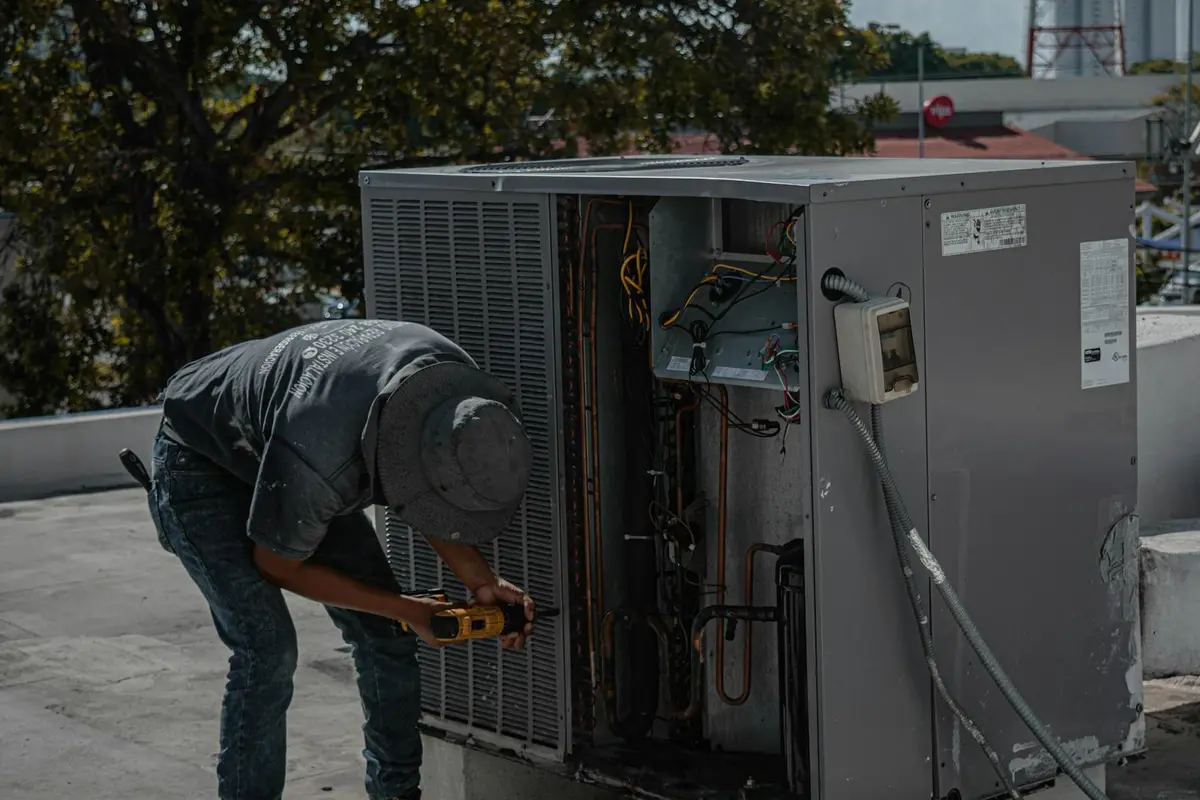
An air conditioner is a two-for-one deal. Its primary job is to remove heat, but it tackles humidity as a direct byproduct of how it works. It pulls your garage’s warm, moist air over a set of very cold pipes called the evaporator coil. The air cools down, and the moisture in it condenses on those cold coils-just like water droplets form on a cold drink can. That water drips into a drain pan and is sent outside. The now cooler, drier air is blown back into your space, which helps prevent garage condensation.
For a garage, you have three main types to consider:
- Window Units: This is the classic box you mount in a window or a specially made wall sleeve. They’re affordable and a common first try.
- Portable ACs with a Hose: These sit on the floor and exhaust hot air through a large hose you run to a window kit. I find them less efficient for a garage. The hose gets hot, and they can be noisy.
- Mini-Split Systems: These have an outdoor compressor unit and a quiet, high-wall-mounted indoor unit connected by refrigerant lines. They’re the most powerful and efficient option by far.
Installation is where the real differences hit your wallet and schedule. A window unit is a DIY project if you have a suitable, sturdy window or are handy enough to frame a wall sleeve. A portable unit is also DIY, but you must seal the window kit tightly. A mini-split is a different beast. While DIY kits exist, I always recommend hiring a licensed HVAC pro. They handle the refrigerant, electrical work, and vacuum testing to ensure it runs correctly and doesn’t fail prematurely.
Will a Window AC Unit Work in Your Garage?
Maybe, but you need to check a few big boxes first. You must have a window of the right size or commit to cutting a hole in your wall and installing a proper supporting sleeve. Garages are often poorly insulated, so cold air leaks out and warm, humid air seeps in, making the unit work harder. There’s also a security concern – a window unit can be a tempting entry point for thieves if not secured well.
The most critical step is sizing it correctly. Garages typically need more cooling power (measured in BTUs) than a living room of the same size because of those insulation issues and often sun-exposed garage doors.
Use this simple chart as your starting point, but when in doubt, size up:
| Garage Size (Approx.) | Minimum BTU Recommendation* |
|---|---|
| 1-Car (12’x20′) | 12,000 BTU |
| 2-Car (20’x20′) | 18,000 BTU |
| 3-Car+ (24’x24′) | 24,000 BTU |
*Assume average insulation. For poor insulation, a metal building, or a lot of sun exposure, add 20-30% more BTUs.
Head-to-Head Comparison: Dehumidifier vs. AC
Let’s put them side-by-side. This table cuts to the chase of what each machine is designed to do in your garage.
| Feature | Dehumidifier | Air Conditioner |
|---|---|---|
| Primary Job | Remove moisture from the air. | Remove heat from the air. |
| Temperature Effect | Warms the air slightly as a side effect. | Cools the air significantly as its main function. |
| Best For | Preventing rust, mold, and mildew in a storage or workshop space. Use year-round. | Making the space comfortable for working or spending time during hot weather. |
| Garage Readiness | Plug and play. Needs a drain or daily bucket emptying. | Often requires special installation (window, wall sleeve, or pro install for mini-split). |
Humidity Control Showdown
A dehumidifier is a specialist, and an air conditioner is a generalist. If your only goal is to stop dampness, a dehumidifier is the more direct and efficient tool. It will run until it hits your target humidity level, regardless of the air temperature.
An AC removes humidity only when it’s running to cool. In a swampy climate, you might need to cool the garage to an uncomfortably cold temperature just to get the humidity down to a reasonable level. In my experience in the Southeast, using a dedicated dehumidifier alongside mild cooling often works better than trying to use an AC alone to battle extreme humidity in the garage.
Temperature Control Showdown
This one is straightforward. If you want to lower the temperature for comfort, an air conditioner is your only real choice. A dehumidifier is not a cooling device. The warm air it exhausts is noticeable in a small, enclosed space. I’ve measured this in my own shop: while pulling pints of water from the air, the dehumidifier can raise the ambient temperature by a few degrees. That’s fine for protecting tools, but it won’t make a summer garage workshop comfortable.
Power Consumption: What You’ll Pay to Run Each
Looking at ac vs dehumidifier power consumption is key to estimating your operating costs. A typical 50-pint dehumidifier might use between 500 to 700 watts when the compressor is running. Think of it like a few old-school incandescent light bulbs. A medium-sized 12,000 BTU window AC unit can draw 1,200 to 1,500 watts-closer to a microwave oven in use.
For true dehumidifier vs ac energy usage facts, don’t guess. The rated wattage on the unit’s label is a start, but how often it cycles on and off changes everything. I plug new gear into an energy monitor plug (like a Kill A Watt meter) for a week. It shows me the real kilowatt-hours consumed in my specific garage environment, which is the number you need for an accurate cost estimate from your utility bill.
Cost & Budget: Purchase, Installation, and Operation

Let’s talk real numbers. I’ve priced these units out for clients and for my own shop many times, and the sticker price is only the beginning.
Upfront Purchase Price
Think of this like buying a tool. You want something reliable that fits your job without breaking the bank.
- Dehumidifier:
- Good ($150): A basic 30-pint model from a brand like Frigidaire. It’ll work for a single-car garage in a moderately damp climate. I find the buckets on these smaller units fill up fast.
- Better ($250): A 50-pint unit with a built-in pump, like ones from hOmeLabs. The pump is a game-changer, letting you drain directly to a floor drain or out a window. This is the sweet spot for most two-car garages.
- Best ($400+): A commercial-grade 70-pint model, such as those from AprilAire. These are built with heavier-duty components and can handle a very wet space or a large workshop. If you have serious moisture issues or expensive tools to protect, this tier is worth the investment for its durability and faster drying.
- Air Conditioner:
- Good ($300): A basic 8,000 BTU window unit. It will cool a small garage but struggles if the space isn’t well-insulated. The constant vibration in a garage can shake cheaper models apart over time.
- Better ($500-$700): A dual-hose portable AC unit. I’ve used a Whynter model like this. It’s more efficient than single-hose portables and you don’t have to install it in a window, but you still need to vent it through a sliding door kit.
- Best ($1500+): A ductless mini-split system. This is a permanent installation. For true temperature control while you’re working, a mini-split is in a different league, offering both cooling and efficient heating.
Hidden Installation & Setup Costs
This is where budgets get blown. Plan for these extras so you aren’t surprised.
- Dehumidifier: That $250 model with a pump? It needs a hose and a place to drain. A 10-foot vinyl hose might cost $15. If your drain is across the room, you may need a small condensate pump kit, adding another $80-$100.
- Window AC: Don’t just jam it in the window. You need a proper support bracket ($40-$80) to prevent it from falling. A foam sealant kit ($20) stops bugs and humid air from leaking in. If your garage outlets are already running a freezer and tools, you might need an electrician to add a dedicated circuit, which can cost several hundred dollars.
- Mini-split AC: The unit cost is just part one. Professional installation, which involves mounting, refrigerant line running, and electrical work, often costs as much as the unit itself. Always get a firm installation quote before buying a mini-split system; the labor is the major expense.
Long-Term Operating Costs
Your electric bill tells the real story. Think about how many months a year you’ll run the machine.
At the national average of about 16 cents per kilowatt-hour (kWh):
– A 50-pint dehumidifier running 8 hours a day might cost $15-$20 a month.
– A 10,000 BTU window AC running for 8 hours a day could cost $40-$50 a month.
Here’s a key lesson from my garage: in cool, damp spring weather, running the dehumidifier is far cheaper than trying to take the chill off with an air conditioner. The AC has to work hard to both cool and dehumidify, while the dehumidifier just tackles the moisture, making the space feel more comfortable without the big energy draw.
Maintenance & Cleaning Routine for Each
Neglect these routines and you’ll buy a new unit twice as fast. A few simple habits keep them running for years.
Dehumidifier Care (Weekly & Monthly)
Treat it like a major appliance, not a set-it-and-forget-it gadget.
- Weekly: Empty the collection bucket, even if it’s not full. Once a month, take it to the sink and wash it with a 50/50 white vinegar and water solution to kill mold and mildew spores. This smell is a sign it needs cleaning.
- Monthly: Unplug the unit. If it has a washable air filter, rinse it under lukewarm water and let it dry completely. Use your shop vacuum’s brush attachment to gently pull dust off the intake and exhaust grilles.
- Seasonal: Before a wet season, check that the continuous drain hose isn’t kinked or clogged with algae. A quick flush with water clears it out.
Air Conditioner Care (Monthly & Seasonal)
Dirty AC units lose cooling power and strain their motors.
- Monthly: For window and portable units, pull the reusable foam filter and wash it in warm, soapy water. Let it air dry completely before putting it back. A clogged filter makes the unit freeze up.
- Seasonal Start-Up: For a window unit, go outside and carefully vacuum the condenser coils (the ones on the back) with a soft brush attachment. Be gentle to avoid bending the thin fins. This helps it expel heat efficiently.
- Seasonal Shut-Down: For a window unit, unplug it, cover it with a proper AC cover (not a plastic bag, which traps moisture), and secure the window. For a mini-split, use the manufacturer’s “dry” or “fan” mode to dry out the inside unit before turning it off for winter.
How to Choose: A Step-by-Step Decision Guide
Don’t overcomplicate this. I use a simple three-step checklist with every homeowner I advise. Follow these steps, and the right choice for your garage becomes obvious.
- Identify Your Main Enemy.
- Evaluate Your Garage’s “Envelope.”
- Consider Your Climate’s Personality.
Step 1: Identify Your Main Enemy
This is the most critical step. You need to name the primary problem you’re paying to solve.
Choose “Moisture/Dampness” if your main issues are rust on tools, a musty smell, mildew on walls, or condensation on the floor, but the temperature itself isn’t a problem. You might be storing classic cars, sensitive woodworking supplies, or just want to stop that damp feeling. Here, a dehumidifier is your targeted, energy-efficient weapon.
Choose “Heat & Moisture” if you actively use the space as a workshop, gym, or hobby room and need the air both cooler and drier to be comfortable. If you find yourself avoiding the garage on summer afternoons because it’s a sauna, you’re fighting a two-front war. An air conditioner handles both battles at once. For a garage that stays cool this summer, simple upgrades can make a big difference. Good airflow and proper insulation help you keep the space comfortable all season.
Step 2: Evaluate Your Garage’s “Envelope”
Think of your garage like a cooler. If the lid doesn’t seal, you’re just wasting ice. Neither appliance can win if it’s fighting a constant influx of outside air.
Before you buy anything, spend an afternoon on this. Check the seal on your service door. Look for daylight around your overhead door. Feel for drafts. Seal gaps around the garage door to cut drafts. A tube of silicone caulk and a kit of rubber bottom seals for your garage door are cheap fixes.
Spending $50 on weatherstripping can make a $200 dehumidifier twice as effective by keeping moist air from sneaking back in. I’ve seen it turn a struggling unit into a perfect solution. Insulating an uninsulated garage door is the next-level upgrade that makes any climate control far more efficient.
Step 3: Consider Your Climate’s Personality
Your local weather decides which tool is the workhorse.
In the Hot & Humid Southeast, your garage is hot and wet for months. An air conditioner is your default choice. It directly solves the comfort problem while pulling out a massive amount of water. A dehumidifier alone in a 95°F garage just leaves you with dry, hot air. That’s where garage climate control air conditioning provides a complete solution, cooling and dehumidifying the space. It keeps the garage comfortable year-round.
In the Cool & Damp Pacific Northwest or during Northeastern springs, the air is chilly and saturated. Running an AC in 60°F weather is wasteful and uncomfortable. A dehumidifier is the star here, quietly pulling moisture out without overcooling the space, protecting your tools and storage perfectly.
When NOT to Try This and Limitations
I have to give you the safety talk first. These are powerful tools, but they have strict rules.
Never use a standard residential dehumidifier in an unheated garage that drops below 40°F. The coils will frost over instantly. I killed a Frigidaire unit this way one cold snap. The compressor iced up and seized. For cold spaces, you need a “low-temperature” or “garage-specific” dehumidifier with an automatic defrost function.
Never install a window AC unit in a framed-in garage window without verifying the structure can hold it. Those frames are often lightweight and not meant for the weight and vibration. A falling AC unit is a major hazard. If you’re cooling a garage temporarily, a portable window AC can offer a safe, flexible option. It’s easy to move and doesn’t require permanent framing changes. I always recommend a through-the-wall sleeve or a mini-split for a permanent, safe installation.
Remember, these are moisture *controllers*, not water *fixers*. If you have active water coming in from a cracked foundation, a leaking roof, or poor drainage, you must fix that leak first. No appliance can pump out a flood.
Finally, standard units are for clean residential air. If you’re doing heavy grinding, woodworking that creates fine dust, or have flammable vapor hazards, you need equipment rated for those environments. The motors and electronics in standard units are not safe there.
Can You Run an AC and Dehumidifier Together?
You can, but you usually shouldn’t. It’s redundant. An air conditioner is already a powerful dehumidifier. Running both is like using a sledgehammer and a regular hammer on the same nail-you’re just wasting energy.
The one exception I’ve made is for a client in coastal Florida with a woodshop. In the spring and fall, it was too cool to run the AC comfortably, but the humidity was still 80%. He used a dehumidifier alone during those “shoulder seasons” to protect his lumber and tools. When full summer hit, he switched to just the AC. That’s a specific, cost-aware strategy, not running them both at the same time.
Quick-Answer FAQ: Garage Moisture & Temperature Control
Can a dehumidifier cool my garage like an air conditioner?
No. A dehumidifier’s job is to remove moisture, and it actually exhausts slightly warm air as a byproduct. If your primary goal is to lower the temperature for comfort, an air conditioner is the only correct tool for that job.
What is the optimal humidity setting for my garage dehumidifier?
Set it between 50-55% Relative Humidity (RH). This level is dry enough to prevent rust and mold but won’t cause the unit to cycle excessively. Use a separate hygrometer to verify the garage’s actual humidity, not just the unit’s reading, especially if you store classic cars in the garage.
I see a lot of debate online (like on Reddit) about this choice. What’s the most common oversight?
People often forget to seal their garage first. No unit can win against a constant draft of outside air. Before buying anything, seal gaps around the service door and install a bottom seal on the garage door-it makes any appliance far more effective.
Should I specifically buy a “garage-rated” dehumidifier?
Only if your garage gets very cold. Standard dehumidifiers fail below 40°F as their coils freeze. For a heated or mild-climate garage, a standard unit is fine. For unheated spaces in cold regions, a low-temperature model with auto-defrost is mandatory.
Is a portable, single-hose air conditioner a waste of money for a garage?
Generally, yes. They are inefficient because they pull your already-conditioned air to cool their condenser, creating negative pressure that sucks in more hot, humid air from outside. A window unit or mini-split is a far better investment for actual cooling.
Can I run my regular dehumidifier in the garage during winter?
If your garage is unheated and temperatures drop near or below freezing, you must turn it off. Unplug it and store it. Running a standard unit in the cold will destroy the compressor. Use it only during the damp, warmer months.
Making the Right Call for Your Garage
After years of hands-on work in residential garages, I’ve learned that the best choice always comes down to targeting your biggest problem-whether that’s sticky moisture or oppressive heat.
- For pure moisture control, a dedicated dehumidifier wins every time. In my shop, I rely on an Aprilaire 1830 because it quietly pulls water from the air without overcooling the space, which is perfect for protecting tools and stored items.
- If you need to lower the temperature for comfort, an air conditioner is the tool for the job. I’ve installed Frigidaire window units for clients who use their garage as a workshop, but remember, while ACs remove some humidity, they’re not as effective as a dehumidifier for that single purpose.
- Your local climate dictates the right choice. Living in the humid Midwest, I run a dehumidifier nearly year-round to prevent mold and rust, whereas in drier regions, a portable AC for occasional summer use might be all you need.
- Prioritize safe installation above all. Always plug these appliances into a dedicated outlet, keep them free of dust and clutter, and ensure proper ventilation-I’ve repaired damage from shortcuts that led to tripped breakers and even minor fires.
Related Guides and Information
- r/hvacadvice on Reddit: Whole home air conditioning vs dehumidifier
- Dehumidifier vs. Air Conditioner: Which One Do You Need?
- Air Conditioning Vs. Dehumidifiers | Mobile Air
- Dehumidifiers vs. Air Conditioners I Southport Home Services
Evan Gunther
Evan is a general contractor operating in Columbus, Ohio servicing, maintaining and building residential and commercial garages for over two decades. He has personally redeveloped over 100+ garages and installed and reinstalled over 230+ garage doors in his long tenure. When it comes to giving your garage a face lift or fixing common issues, Evan's the pro. Feel free to reach out to him and follow his Garage Log blog for expert, fact based advice.