
How Do You Prepare and Paint Your Garage Walls, Ceilings, and Floors to Last for Years?
If you’re concerned about paint peeling off your walls or oil stains ruining your floor, you’re in the right place. I’ll break down the exact preparation and painting process I use in my own shop to achieve a durable, professional-looking finish.
This article provides a step-by-step plan covering surface cleaning and repair, selecting the correct paint and primer for each material, and the application techniques that prevent early failure.
I’ve personally transformed dozens of residential garages, learning through trial and error which products and methods actually stand up to chemicals, moisture, and impact.
Start Here: What’s Your Garage’s Job?
Before you grab a paint chip or a brush, you need to look at your garage as a tool. I’m not talking about a hammer or a drill, but the whole space. Its job dictates everything you’ll do next. Is it a fine woodworking shop where dust control matters? A greasy car project bay? Or just a clean storage room for holiday decorations and bikes? Your answer changes the game.
For a workshop, you need a tough, scrubbable wall paint that can take a bump from a 2×4. For car work, you need a floor coating that laughs at brake fluid and oil drips. For simple storage, a basic interior latex might do the trick, but you’ll still want it to last. Figuring this out first saves you money and regret.
Next, do a quick detective walk. Put on a headlamp and look closely. Check for moisture at the bottom of walls or along the ceiling, feel for dampness on concrete, and look for old, dark oil stains that feel slick. Tap on the walls. Is that paint chalking off like dust? Is it peeling? This inspection tells you what you’re fighting. If you’re painting aluminum metal garage doors, use a primer formulated for aluminum and a paint with strong exterior durability. That prep helps ensure adhesion and a long-lasting finish, even in humid garage environments. It also answers common search questions right here. Can you paint a metal garage door? Absolutely, but you must treat rust first. Can you use exterior paint inside your garage? You can, and for uninsulated spaces, its mildew resistance and durability are often a smart choice.
DIY Difficulty & Time Estimate
I rate this entire project a solid 7 out of 10. It’s not brain surgery, but it is a serious test of patience. The prep work is 80% of the effort and the part you cannot cheat. If you skip steps here, the paint will fail, guaranteed.
For a standard two-car garage, block off 2 to 3 full days just for the active work: moving everything out, cleaning, making repairs, and masking. The painting itself goes relatively fast. Then, you must add drying and curing time. Plan for the space to be out of commission for 3 to 7 days total. You can’t park a car on a freshly coated floor for at least 72 hours, especially when renewing or resurfacing the paint.
I strongly recommend a helper, especially for the ceiling. Holding an extension pole steady for hours is tiring, and moving heavy tools and workbenches solo is a great way to hurt your back or scratch a wall you just prepped.
The Pro’s Prep Work: Cleaning and Fixing Walls & Ceiling
This is where jobs go right or wrong. Cleaning doesn’t mean swiping a dusty wall with a dry rag. You need to remove the invisible film of grease, dust, and grime that paint cannot stick to. For this, you need chemistry and elbow grease.
My go-to for years has been a heavy-duty degreaser like Simple Green or a TSP substitute. Mix it in a bucket as directed. Use a stiff nylon-bristle scrub brush-the kind with a handle-and really work it into the walls and ceiling. On textured surfaces, you have to dig in. You’re not just moving dirt, you’re emulsifying oils so they can be rinsed away. I then use a wet/dry shop vac with a squeegee attachment to suck up the dirty water. For rinsing, a clean mop and bucket of fresh water works, or a garden sprayer if you have a floor drain.
How to Repair Cracks, Holes, and Stains
Once it’s clean and dry, you’ll see every flaw. Here’s how I fix the common ones.
For drywall:
- Small nail holes: Use a lightweight spackle like DAP Fast ‘n Final. It dries fast and sands easy. Smear it on with a 4-inch putty knife, let it dry, and sand it smooth with 120-grit paper.
- Larger holes or cracks: Use a setting-type joint compound, like USG Durabond. It comes as a powder you mix. It’s harder and more durable than pre-mixed spackle for big fixes. Fill the hole, scrape it flat, let it set, and sand.
For stains:
- Rust stains on metal doors or beams: Sand the area down to bare metal with 80-grit sandpaper. Then, immediately wipe it with a rag dampened with mineral spirits to remove dust. You must prime this with a rust-inhibitive primer like Zinsser Cover Stain. I use an oil-based version for this job because it seals the stain completely.
- Old oil stains on concrete walls or floors: Wiping isn’t enough. Use a dedicated concrete degreaser or even acetone. Pour it on, scrub, and let it soak. You may need multiple applications. The stain might not vanish, but you need to neutralize it so your primer can bond.
The Gearhead’s Checklist for Prep
Gather these tools before you start. Trying to improvise mid-job wastes time.
- Cleaning: Heavy-duty degreaser (Simple Green), stiff nylon scrub brush, 5-gallon buckets, garden sprayer or mop, wet/dry shop vac (my Milwaukee Packout vac is a beast for this).
- Repairs: 4-inch putty knife, 6-inch taping knife for big areas, sanding block, 80-grit and 120-grit sandpaper, lightweight spackle, setting-type joint compound, rags, mineral spirits.
- Masking & Safety: I prefer 2-inch paper masking tape, like 3M’s, for edges. It tears cleanly and doesn’t leave residue like some cheap tapes. Also, get a good box of nitrile gloves, safety glasses, and a respirator for sanding dust and working with chemicals.
Choosing Your Weapons: Primer and Paint for Garage Surfaces
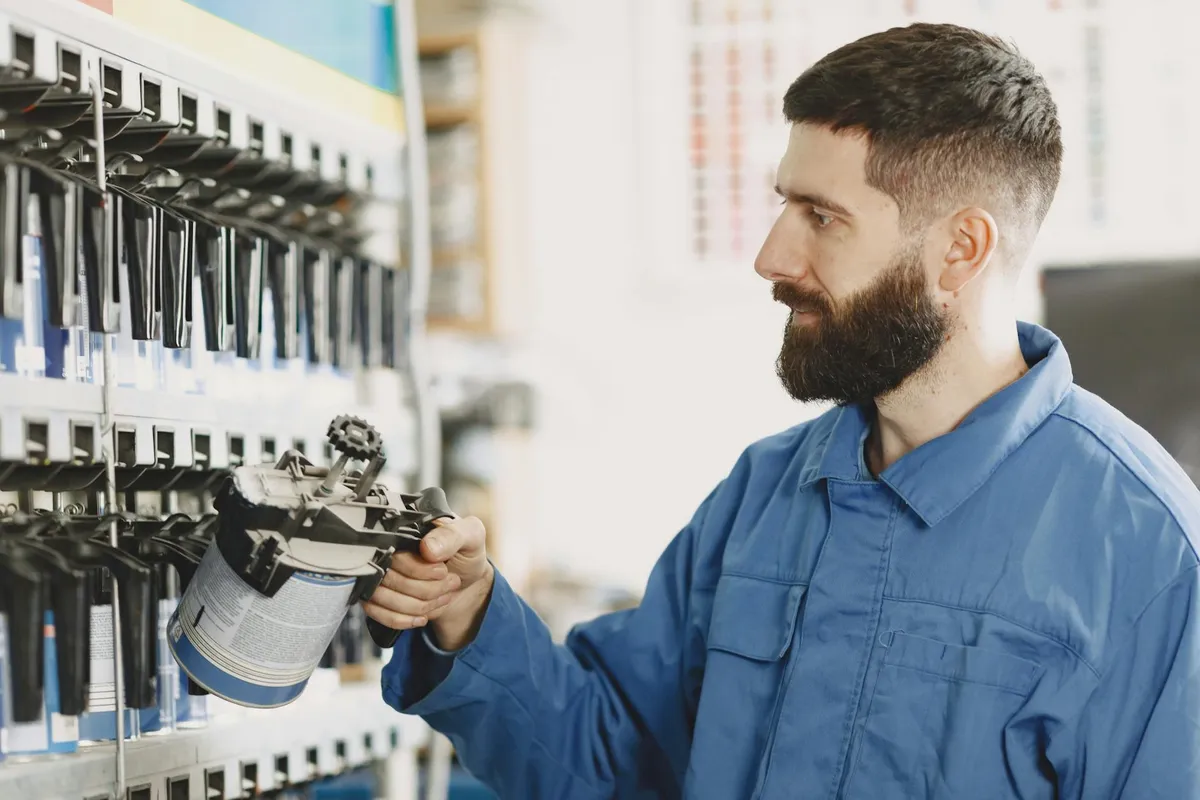
Getting this part right separates a job that looks good for a year from one that lasts a decade. The primer and paint you choose are your most important tools.
Primer: Your Secret Weapon for Adhesion
Primer is not just thinned-out paint. It’s a specially formulated glue that sticks to your wall or floor and gives your finish coat something to hold onto.
For drywall and painted walls, you have two main choices. An oil-based primer, like Zinsser Cover-Stain, is the king of stain blocking. I always keep a can of Zinsser Cover Stain on my shelf for sealing water marks, grease spots, or smoke stains; it smells strong and you need mineral spirits for cleanup, but it locks stains in place so they never bleed through your new paint. For most other walls, a high-quality, high-adhesion water-based primer is my go-to. Brands like Kilz Max or Sherwin-Williams Multi-Purpose Primer stick well, dry fast, and clean up with soap and water.
For concrete floors, you cannot skip a dedicated bonding primer. Wall primer will fail here. You need a product labeled for concrete, like Sherwin-Williams Loxon or an epoxy primer that comes with a coating kit. This primer soaks into the concrete’s pores and creates a chemical bond that paint alone never could.
Paint and Coatings: What Actually Lasts
Picking the right sheen and type of finish is a practical decision, not just a cosmetic one.
On walls, use a semi-gloss or satin sheen. The slight shine makes them easy to wipe down when they get dusty or splashed. For the ceiling, use a flat sheen. It does a better job of hiding minor imperfections and uneven textures. I use a good quality exterior-grade acrylic latex paint for garage walls; it’s tough and handles temperature changes well.
For floors, understand the difference. A “garage floor paint” is usually just a thick latex paint. It’s a budget option that will wear off in high-traffic areas. A two-part epoxy coating is a chemical reaction that creates a plastic-like, incredibly durable surface. It’s what you see in professional shops. For the ultimate protection, a polyurethane topcoat goes over the epoxy to add UV resistance and an even harder, glossy shell. When deciding between epoxy vs paint for a garage floor, durability and maintenance should drive the choice.
Spray painting a bike frame is fine if you open the door. Painting an entire car inside the garage is a different story. You need explosion-proof fans and a proper respirator. For small projects, always wear a mask rated for organic vapors, not just a dust mask. Also, make sure to store paint properly to prevent spoiling.
Concrete Floor Prep: This is the Hard Part
Prepping the floor is 90% of the job. If you skimp here, your beautiful coating will peel up no matter how much you spent on it.
Etching vs. Grinding: Opening the Concrete’s Pores
Your coating needs a rough, open surface to grip. You have two ways to get it: etching or grinding.
Etching uses acid to eat away a microscopic layer of concrete. You can use traditional muriatic acid (handle with extreme care, it’s dangerous) or a safer, citric-acid based product like Concrete Prep from the big box stores. Etching only works on new, clean, bare concrete that has never been sealed or painted. For a garage floor painting project, this etching step is a common prep to ensure the finish adheres properly. A well-etched surface improves paint bond and durability for a long-lasting result.
For any other floor-one with an old sealer, existing paint, or deep oil stains-you must grind it. I rent a diamond-grinder edger from my local tool rental. It’s a loud, dusty job, but it’s the only way to be sure. I learned this the hard way: I tried etching an old, sealed floor once to save time, and the new epoxy coating peeled up in sheets within six months. Now, for any floor that isn’t brand new, I always grind. Remember to wear a tight-fitting P100 respirator, goggles, and hearing protection when grinding.
Repairing Cracks and Spalling
After cleaning and degreasing the floor, you must fix the damage before you coat it.
- For hairline cracks, use a thin, liquid epoxy concrete crack filler. I like the Semco Liquid Crack Filler kit. You mix the two parts and pour it into the crack; it’s thin enough to seep deep down and bond the sides together.
- For larger holes, pop-outs, or spalling (where the surface flakes off), you need a vinyl concrete patcher. Brands like Quikrete Vinyl Concrete Patcher work well. Chip away any loose material, wet the hole (a damp surface helps it bond), trowel the patcher in, and smooth it flush.
Let all repairs cure completely according to the package instructions before you apply any primer or coating.
The Application: Putting It All On the Walls, Ceiling, and Floor
Plan for two coats of paint on your walls and ceiling. One coat almost never gives you complete, even coverage, especially over primer or a different color. The first coat soaks in and the second one builds the finish. For floors, follow the product instructions to the letter. Most 100% solids epoxy kits are a single, thick coat, while some polyaspartic or acrylic sealers might need two thinner applications.
The time between coats is critical for good results; recoat too soon and you risk pulling up the previous layer. For latex wall paint in good conditions (65-85°F), you can usually apply the second coat in about 4 hours. Floor coatings have a specific “recoat window,” often between 12-24 hours. If you miss that window, you might have to wait a full week and sand before applying the next coat.
Sequence for Success: Ceilings, Walls, Then Floors
Always work from the top down. Paint your ceiling first, then the walls, and the floor last. This way, any drips from the ceiling land on unpainted walls you’ll cover later, and splatter from the walls lands on the bare concrete floor.
For ceilings and high walls, an extension pole for your roller is a must. I use a sturdy, telescoping pole that lets me keep my feet on the ground. Start by “cutting in” all the edges with a 2-3 inch angled sash brush-I prefer a Purdy brush for its clean lines. Then, use a 1/2 inch nap roller cover on the pole to fill in the large areas. Work in small, manageable sections, about 3×3 feet, and keep a wet edge to avoid lap marks.
Floor application is a two-person job for anything bigger than a single car bay. Mix your epoxy or coating thoroughly and pour it in a long, thin line across the floor. One person spreads it with a notched squeegee to get an even thickness. The other person follows right behind with a specialty epoxy roller cover (I use the 3/8 inch nap ones from RollerMate) to pop bubbles and create a consistent texture. Work your way backward toward the garage door so you don’t paint yourself into a corner. Epoxy paint for your garage floor is key to a durable and attractive finish.
Drying and Curing are Not the Same
Paint can feel dry to the touch in a few hours, but that’s just the surface. Full curing, when the paint has reached its maximum hardness and chemical resistance, takes much longer. For latex wall paint, it can take 2-3 weeks to fully cure. You can put things back on the walls after a day or two, but be gentle.
A floor coating is most vulnerable in the first 72 hours after application. It will feel dry, but it’s still soft underneath and can be easily dented or stained. Do not drive on it, place tools on it, or drag anything across it for a minimum of three full days. I tell clients to block the garage for a full week if possible. Humidity and cold temperatures can double these cure times.
Safety and Long-Term Care for Your New Garage
Non-Negotiable Safety Gear and Ventilation
Your lungs and skin need protection. A simple dust mask does nothing for chemical vapors. You need a NIOSH-approved respirator with organic vapor cartridges, like the 3M 6000 Series. Pair it with chemical-resistant nitrile gloves and basic safety glasses.
Ventilation means moving air, not just having an open door. I set up a box fan in a rear window, facing outward, to actively pull fumes out of the garage. Open the main door a few inches to create a cross-flow. Run the fan for at least 24-48 hours after applying a floor coating. This is part of improving garage air circulation ventilation. Consistent airflow helps remove fumes faster and keeps the space safer.
Never use spray paint or paint a vehicle in an attached garage, even with the door open. Fumes can seep into your home’s living spaces through walls and ductwork, creating a serious health and fire hazard. Many local fire codes explicitly prohibit this. For any spray work, do it outside or in a detached, well-ventilated space.
Maintenance & Cleaning Routine
Caring for your new surfaces is straightforward. For painted walls and ceilings, dust them occasionally with a soft brush or microfiber mop. For cleaning, use a pH-neutral cleaner like Simple Green diluted in water. Avoid harsh degreasers or abrasive pads that can dull the sheen.
On a coated floor, wipe up oil, coolant, or chemical spills immediately with an absorbent cloth. For general cleaning, a damp mop with that same mild cleaner works perfectly. Do not use bleach or ammonia-based products, as they can degrade the coating over time.
Once a year, do a quick walk-around to look for any chips or lifting edges in the floor coating, especially near where tires sit. Most kits come with a small touch-up bottle. Scuff the chip with sandpaper, clean it with denatured alcohol, and dab on the repair epoxy. This small step prevents moisture from getting underneath and causing larger sections to peel.
With proper prep and application, a quality latex paint job on your walls should look great for 5 to 10 years. A professional-grade two-part epoxy or polyaspartic floor coating, maintained as described, can easily last 10 years or more before needing a full recoat.
Garage Painting & Coating FAQs: A Pro’s Quick Answers
What type of primer is best for garage walls and ceilings, and why is it important?
Your primer choice is a non-negotiable foundation. For stains (water, grease, rust), use an oil-based, stain-blocking primer like Zinsser Cover Stain-it’s the only thing that truly seals them in. For all other clean, dry surfaces, a high-adhesion, water-based primer provides excellent grip and easy cleanup. Priming ensures your topcoat bonds properly and lasts for years.
What is the difference between epoxy, polyurethane, and acrylic concrete floor coatings?
They are different levels of protection. A two-part epoxy is a thick, chemically-cured plastic-like coating that offers the best durability and chemical resistance for a DIY project. Polyurethane is often used as a clear topcoat over epoxy for added UV resistance and hardness. Acrylic sealers are thin, paint-like coatings; they’re a budget option but will wear quickly in a working garage.
What steps are necessary for etching or grinding a concrete floor before applying a coating?
This is the critical step. For new, bare concrete, you can etch it with acid to open the pores. For any existing sealed or painted floor, you must mechanically grind it with a diamond-grinder. Grinding is the only guaranteed method to create the rough profile needed for the coating to achieve a permanent bond. Never skip this.
How many coats are typically needed, and what’s the rule for drying time between coats?
Always plan for two coats on walls and ceilings for even coverage and color depth. The golden rule is to recoat only when the previous coat is dry to the touch *and* within the product’s specified “recoat window.” For latex paint, this is usually 4 hours; for epoxies, it’s a strict 12-24 hour window. Missing it requires a full cure and sanding before the next coat.
What safety precautions are most often overlooked when painting in a garage?
Ventilation and respiratory protection are underestimated. An open door isn’t enough-use a box fan in a window to actively exhaust fumes. Always wear a NIOSH-approved respirator with organic vapor cartridges, not a dust mask, when using primers, epoxies, or solvents. Your lungs are not disposable.
What’s the single best way to prevent peeling or chipping on garage surfaces over time?
Impeccable preparation is 90% of the battle. The other 10% is an annual maintenance check. Once a year, inspect for any chips, especially on the floor near tires. Immediately sand, clean, and touch up any damage with the correct product to prevent moisture from getting underneath and causing larger failures.
Final Coat, Lasting Protection
If you remember one thing from this guide, let it be this: your prep work dictates your paint’s lifespan. Treating the surface correctly is not a suggestion; it’s the requirement for a finish that lasts for years. Invest your time in meticulous cleaning, etching, and priming, and the actual painting becomes the easy, rewarding part. Focus on these three principles for professional results: clean every surface until it’s dust-free and grease-free, never skip the manufacturer-recommended primer for your specific material, and maintain good airflow with fans during application and for days after to let the paint cure hard.
Evan Gunther
Evan is a general contractor operating in Columbus, Ohio servicing, maintaining and building residential and commercial garages for over two decades. He has personally redeveloped over 100+ garages and installed and reinstalled over 230+ garage doors in his long tenure. When it comes to giving your garage a face lift or fixing common issues, Evan's the pro. Feel free to reach out to him and follow his Garage Log blog for expert, fact based advice.